MARKETS SYDNEY TOKYO LONDON NEW YORK
LIVE
--:--:-- UTC
FX
[ FETCHING RATES... ]
// LIVE FEED //
[ SCANNING... ]
[ SCANNING... ]
FEED
◆ EUR/USD ◆

90% Of New Traders, Lose 90% Of Their Starting Capital, within Just 90 Days.


There are, probably around 75% that don’t make it as traders depending on who you ask. I would think it’s a matter of attitude towards speculation as trading is. 

It looks easy when beginners study past price action, trending up and down, how can you lose after you did so well in demo trading? 


It’s a different game when you are at the right hard edge with nothing but an empty chart staring at you and you will decide if you will put your money at risk. 

Risk your money into the future that has not happened yet. A common trick in trading is painted bars. The market makers who have the software that print the price bars manipulate it to arrange the price bars in a way that the chaos is replaced by bars that show predictable price action like there is nothing to it.

They even add a bar that doesn't exist in the first place, by painting one into the future and make it appear at the present to make room for the next, genuine bar. Then you have fake moves, stop loss hunting, liquidity traps that stop you out with losses. 

The big money needs your money to create the liquidity they need when the market opens and liquidity can be low. Without it their enormous positions will move the price to their disadvantage and reveal at what price they are buying or selling which will attract others and the price will move. 

Essentially, given what we know about the power of institutional order flow as discussed in the BIS report it makes sense that we would look to trade in the same direction as these major institutions and essentially piggyback their order flow.


The chart above shows the Non-Commercial positioning in GBPUSD going back to 2012 with the Yellow line representing price and the shaded blue region tracking positioning.  When the blue shaded region (positioning) crosses above the center line, it represents a net-long position, and when it crosses below the center line it represents a net-short position. The red circles highlight periods when positioning flipped from long to short and the green circles highlight period where the positioning flipped from short to long.

Of the eight times positioning crossed over 6 resulted in the development of a significant trend. This is incredibly valuable information to have, and the opportunities it can afford should be clear. Looking to trade in the same direction as Non-Commercial players can help individual traders catch major trends.


Another chart that clearly demonstrates the power of this data is the USDJPY chart showing the JPY positioning. This time, the data is inverted so the positioning tracks JPY but price shows USD movement. So if JPY positioning is going down,  as shown by the first red circle, then USD should be going up and vice versa.

COT Data

Fortunately, The CFTC compiles weekly Commitment of Traders data reports on the positioning of participants in the currency futures markets, data which translates directly into the spot FX markets.

The data tracks the positioning of Non Commercial players (banks and institutions) as well as Commercial players (Corporates) and Private clients. The weekly report released each Thursday/Friday references the positioning of these players over the weekly period from the Tuesday of the previous week to Tuesday of that week.

The report is long and complicated for new traders, though fortunately many websites now present the data taken from those reports in neat visual graphics updated each week.

We all like the concept “buy low, sell high” - “sell high, buy back low”(when you short the market) and the big players are no different. The only way to solve it used to be to play in the same direction as the big players, then you win. Trading against the big players via all the traps they arrange for you is a dead end. 

But with the coming of AI and the bots that are already here, HFT-High Frequency Trading is no longer available only to the pros.


Trump’s Influence on Crypto


As money continues to pour into crypto following Donald Trump’s victory last week, bitcoin has climbed to yet another record high.

Bitcoin Reaches Historic $90,000 Level: Bitcoin surged this week, testing an unprecedented resistance level near $90,000, before easing slightly on Tuesday. The excitement stems from increased confidence after Donald Trump’s election win and anticipated pro-crypto policies.

Crypto Price Update: Bitcoin’s price currently hovers at $87,845, with slight retracements as traders sentiment normalizes. Ethereum, the second-largest cryptocurrency, saw a recent rally to $3,430 but has now settled around $3,174.

Trump’s Influence on Crypto: Trump's victory is fueling optimism in the crypto space. He has pledged to make the U.S. a "crypto capital," planning policies to boost high-risk assets like Bitcoin. His stance could support a friendlier regulatory environment and further growth in the crypto market.

Potential National Bitcoin Stockpile: Trump has announced plans to establish a national Bitcoin reserve, which would lend Bitcoin added credibility as a legitimate investment vehicle.

Inflation Data in Focus: With the focus now shifting to upcoming U.S. inflation data, market watchers are eager for cues on how Trump's policies could influence economic growth and inflation.

Geopolitical Impact: Escalating tensions in the Middle East, particularly between Israel and Hamas, are driving a cautious sentiment among investors, reducing demand for high-risk assets like cryptocurrencies.

Investors are showing enthusiasm for the "Trump-trade" in advance, with anticipation high for a pro-crypto stance in the upcoming administration. Many from Trump's close circle, including Vice President-elect JD Vance, are known crypto supporters, hinting at a positive direction for cryptocurrency.

Retrieve Blogspot Security CNAME Record


Here's how you can check your security CNAME record, generated for a specific Google account and domain:


Click on [Search property]


Select your Domain or URL property (the one for the root domain, without www)

If you do not have one you can create new

Scroll down the left sidebar

Click on the Settings tab

Select Users and permissions


Click the three dots next to the email marked as "(you)" (More actions on the right)

select Ownership verification details


Copy your Domain name provider details

Add that unique CNAME record (DNS settings at your domain provider) example at Cloudflare/Cloudns/Hurricane Electrics

Wait ~15-60 minutes


Economic Calendar Widget

Get That Linux Feeling on Windows


Cygwin is a collection of tools developed by Red Hat to provide similar behavior to Unix systems on Microsoft Windows

It is awesome you can get that Linux feeling on Windows many others would to love it, and if I couldn't install Linux for some reason, I'd probably spend my entire life in Cygwin.


It is a way to run native Linux apps on Windows a Linux-like environment on Windows. You must rebuild your application from source if you want it to run on Windows in a way to magically make native Windows apps aware of UNIX® functionality like signals, ptys, etc. Again, you need to build your apps from source if you want to take advantage of Cygwin functionality.


Cygwin was originally developed by Cygnus Solutions, which was later acquired by Red Hat since 2000. Cygwin is a UNIX environment for Windows that's maintained by Red Hat and other vendors. 

POSIX compatibility library for Windows, a toolchain (compiler, linker, assembler, debugger, etc.) built around that library. Cygwin gives you a Unix-like environment on Windows. It consists of a DLL (cygwin1.dll), which acts as an emulation layer. It has a lot of standard tools you'd encounter in a Linux or BSD system. 


If you are a coder, stacks Dev you'll required for a tool that allows easy porting of many Unix programs without the need for extensive changes to the source code.

Features:

The main advantages of using Cygwin are:

Ability to compile programs for Linux (eg, those that use POSIX libraries). This is very useful for learning to program because Windows is the only major OS lacking POSIX compatibility (in some versions of Windows, anyway).

Overview :

Run Linux programs: Users can interact with Cygwin through a Unix shell, such as bash, tcsh, or zsh, and issue Unix commands like grep, mkdir, and chmod.

Running Irssi as a modular IRC client with Perl scripting. 

Create a Linux server: Cygwin can be used to create a Linux server and run such Perl/Pyhton/Ruby etc from the libraries

Compile and run Unix-like source code: Cygwin allows users to compile and run source code for Unix-like operating systems on Windows to make an extensively used of a gcc (gcc-g++, specifically), there's a "make" package.

Best Browsers Ad Blockers

 Adblock for Youtube™


Features:

 + blocks ads, banner and popups
 + blocking of ads on external sites which load Youtube
 + prevent preroll ads from loading on Youtube
 + you can also remove annotations from videos and musics (see options page).
 + loads videos and YouTube website faster.

Overview

Removes ads from Youtube™.

✓ Permissions: like common ad-blocking extensions we do need default permissions on every website to remove ads or popups for example on embedded videos and Youtube itself.

ⓘ About
Adblock for Youtube™ is a content filtering and ad blocking browser extension which blocks all ads on Youtube™.
It allows users to prevent page elements, such as advertisements, from being displayed. 
Banner, Ad-Clips or even preroll ads you usually see before the actual video on Youtube are blocked by this extension.

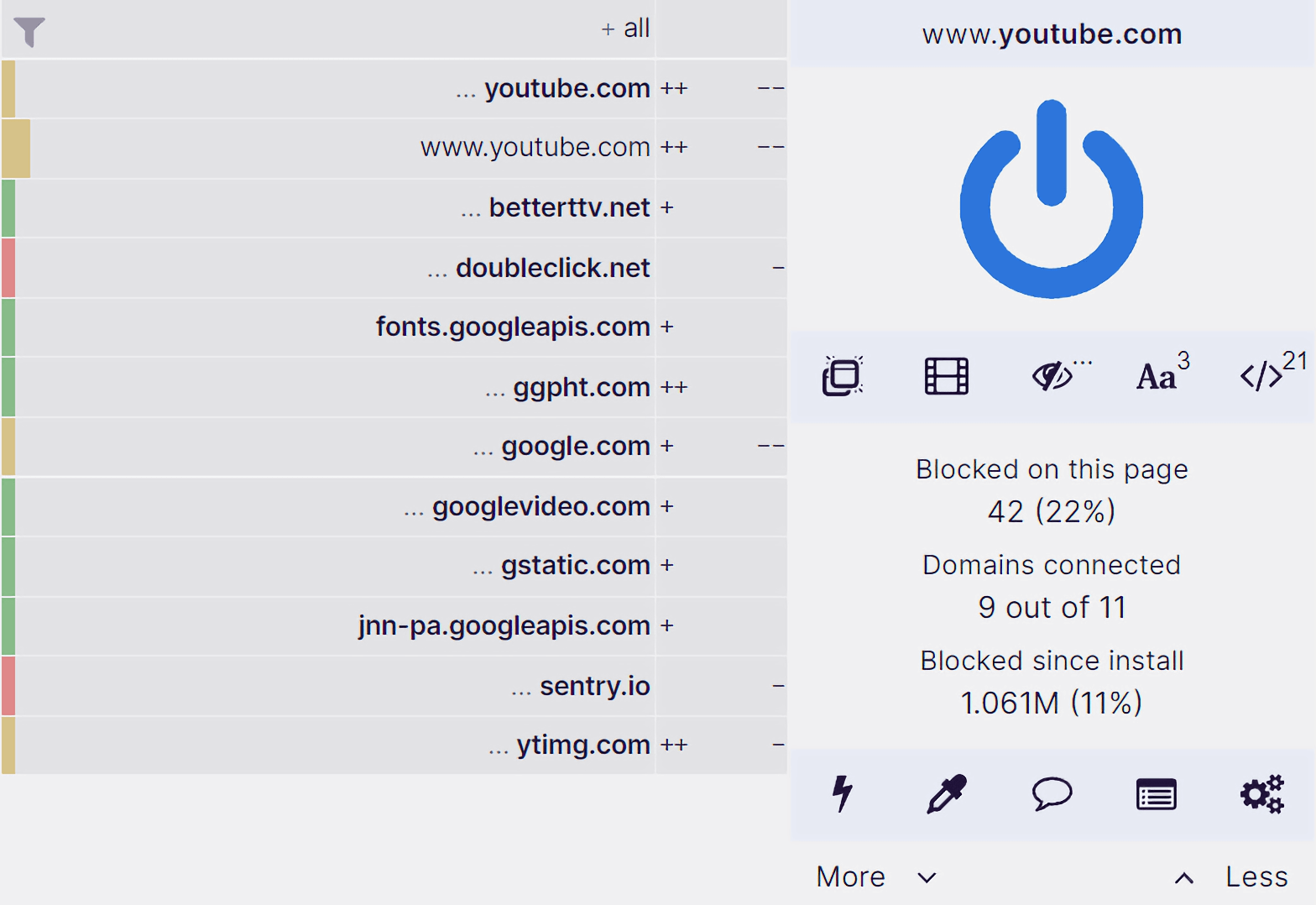
uBlock Origin


Overview

Finally, an efficient blocker. Easy on CPU and memory.

IMPORTANT: uBlock Origin is completely unrelated to the site "ublock.org".

uBlock Origin is not an "ad blocker", it's a wide-spectrum content blocker with CPU and memory efficiency as a primary feature.

***
Out of the box, these lists of filters are loaded and enforced:

- uBlock Origin filter lists
- EasyList (ads)
- EasyPrivacy (tracking)
- Peter Lowe’s Ad server list (ads and tracking)
- Online Malicious URL Blocklist


More lists are available for you to select if you wish:

- Annoyances (cookie warnings, overlays, etc.)
- hosts-based lists
- And many others

uBlock Origin is not just an “ad blocker“, it's a wide-spectrum content blocker with CPU and memory efficiency as a primary feature.

In 2014 uBlock Origin’s founder, original author and lead developer, Raymond Hill, created the original uBlock extension, with its development initiated by forking the codebase of HTTP Switchboard with a separate blocking extension, uMatrix, which had been previously designed for advanced users. 

Free.

Open source with public license (GPLv3)
For users by users.

If ever you really do want to contribute something, think about the people working hard to maintain the filter lists you are using, which were made available to use by all for free.

DNS Blocking Malaysia


Malaysia is implementing DNS block. All 3rd party DNS will be redirected to TM DNS instead. 1.1.1.1 and 8.8.8.8 will return 404. Malaysia’s DNS censorship policy is a global threat to Internet freedom. The Malaysian Communications and Multimedia Commission (MCMC) has made quite a stir earlier this month when it ordered internet service providers (ISPs) in the country to redirect DNS queries that are sent to alternative DNS providers back to their own servers.

The MCMC said at the time that the move was aimed at safeguarding the public from “harmful content,” namely the websites “related to online gambling, pornography, copyright infringement, scams, and other violations of Malaysian law.”

In the context of the Malaysia watchdog’s order for ISPs to redirect DNS queries, this means that if users try to use alternative DNS providers (like Google DNS, Cloudflare DNS, or AdGuard DNS), their queries will be intercepted and redirected to the ISP’s own DNS servers. That is all ostensibly for the purpose of protecting them from “harmful” websites.

However, it will be much more challenging for ISPs to do the same with the user requests sent over encrypted DNS protocols. Encrypted DNS protocols, while not yet mainstream, are gaining traction as they address the privacy issues inherent in unencrypted DNS. Several secure protocols are used to transmit these encrypted requests. The most widely adopted are DNS-over-HTTPS (DoH) and DNS-over-TLS (DoT). There is also a new cutting-edge protocol — DNS-over-QUIC (DoQ) that is superior to those two in terms of speed and reliability.

From a technical standpoint, such a feat is possible because ISPs have control over the DNS traffic that passes through their networks. However, an important distinction should be made here. If you use an unencrypted, plaintext DNS server that uses either IPv4 or IPv6 protocols to return IP addresses, then your Internet provider can see what websites you’re visiting. That means your DNS queries and responses can be read, intercepted and potentially modified by anyone who has access to the network traffic, first and foremost, your ISP. Historically, the DNS traffic has been unencrypted, so this is the case for most users.

Malaysian government and MCMC is rolling out its DNS block, starting with Kuala Lumpur - Selangor area. We used to use DNS to bypass MCMC block in order to access blocked website like MalaysiaKini, SarawakReport and etc.


With the DNS block, we can no longer access the public DNS like CloudFlare DNS, Google DNS, therefore all domain name (like www.MalaysiaKini.com) will be resolved by TM DNS. If TM DNS is blocking the domain, then we may no longer connect to the website itself.

In short, Malaysian government is upping its game in Internet censorship, effectively doing what China's Great Firewall has been doing.

The only solution will be VPN (at the moment, before they implement VPN block)

Current known affected ISP including Maxis, TM, TIME.

Add A Video And Images To A Blog Post


 Add a video and images to a blog post

You can add photos, videos, and other images to your blog posts. You can manage and delete images you’ve uploaded to your blog at http://blogger.com/mediamanager.

According to Blogger's copyright policy, you’re not allowed to add:  Content that’s hosted by someone else without their consent any copyrighted material without authorization and any content that violates the Blogger content policy.

Add an image to a blog post

Images uploaded to Blogger may be compressed and optimized for the web, which results in less data usage and faster load times for readers. These images will not count against your Google storage quota. Currently there’s no way to store large images in original quality on Blogger.

To add an image to your blog post:

Sign in to Blogger. In the top left, select a blog. Click the post you want to edit or create a new post.
At the top, click Insert image Insert image. Choose from where you want to upload the image.
Select one or more images and click Insert. To change the size, caption, or alignment of the image after you add it, click the image. 

Add a video to your blog post

Sign in to Blogger. In the top left, select a blog. Click the post where you want to add a video.
At the top, click Insert video Insert a video. You can upload a video from your computer or choose a video from YouTube. Select a video and click Insert.

Manage your videos

If you’re a blog owner: You can view, download, and delete all videos uploaded to your blog. 
If you’re a blog author: You can view, download, and delete videos that you’ve personally uploaded to your blog. 

To download or delete a video:

Sign in to Blogger. In the top left, select a blog. From the menu on the left, click Settings. 
Under "Manage blog," click Videos from your blog. Select a video from your video library. 
To delete it: click Delete. To download it: click Download.


Fix issues with images and videos

If you have problems when you try to upload images or videos to your blog, try these steps:

Clear your cache and cookies.

Turn your pop-up blocker off or, in your browser settings, allow pop-ups from Blogger.com.
Turn off any plugins you’ve installed on your browser. Make sure you’ve installed the latest version of your browser.


The Best Two Way Cloud Sync/Transfer Application


MultCloud is an international software company established in 2012.  It is an Cloud services platform app that enables you to connect all your cloud drives in one place and transfer files from one cloud to another without the process of downloading and reuploading.

MultCloud's founder is Guy Levi. Headquarters in Asia-Pacific (APAC), Association of Southeast Asian Nations (ASEAN), Southeast Asia. 

Email Address: support@multcloud.com.

Address: 60 PAYA LEBAR ROAD, #08-55, PAYA LEBAR SQUARE, SINGAPORE 409051.

MultCloud, which allows you to connect multiple cloud drives, including iCloud Drive, iCloud Photos, Google Drive, Google Photos, OneDrive, Dropbox, Flickr, MEGA, SharePoint, Dropbox, etc. in one place.

It is a great cloud-to-cloud transfer-and-sync tool that combines a friendly interface with great prices. However, if you want to experience more features and get more data traffic every month, then you can subscribe to the premium plan.

It has the free version as well as the paid version. For free accounts, you can get 5GB of data traffic provided by MultCloud every month to transfer files from one cloud to other clouds and for good reason. It streamlines every aspect of the cloud storage management process, enabling simple transfers and syncing between platforms. 


This week I had tested to migrated for a personal Google Drive account to Onedrive. It was about 5 GB of data migrating and was running very smooth process i just let it's run in the background without needing to monitor it until the task is complete.

Its free plan is excellent, the user interface is intuitive and easy to navigate, and more than 30 cloud storage platforms are supported. If you’re looking for a tool to help you manage multiple cloud storage accounts, you have to recommend MultCloud as one of the top choices.


Pricing

Free Data : 5GB / Month

FREE : $0

5GB free data traffic per month

Convert 50 Emails per Month

2 threads for data transfer


Limited Data : 1200GB / Year

Annual Payment : $119.88 $59.99

1200GB data traffic per year

Unlimited Emails Conversions

10 threads for data transfer

Scheduled transfer/sync/backup


Limited Data : 2400GB / Year

Annual Payment : $239.76 $99.98

2400GB data traffic per year

Unlimited Emails Conversions

10 threads for data transfer

Scheduled transfer/sync/backup


Yearly Unlimited  

Annual Payment : $299 $119

Unlimited data traffic per year

Unlimited Emails Conversions

10 threads for data transfer

Scheduled transfer/sync/backup


MultCloud's Lifetime 

Unlimited Data plan costs $628 $249

Onetime payment, lifetime use

Unlimited data traffic for a lifetime

Unlimited Emails Conversions

10 threads for data transfer

Scheduled transfer/sync/backup


What payment method can I use?

Accepted with Visa, MasterCard/Euro Card, Discover, American Express, Diner's Club, JCB, and check cards or ATM cards connected with one of the major credit card companies listed above. We also accept Bank/Wire Transfer, Check/Money Order, Fax - Credit Card, Invoice.


Adding Read More & Thumbnail in Blogger


Blogger: clickable thumbnail with auto readmore

If you are using a blogger platform of Google then you would probably facing an issue with your blog post to make the "Read More" and the "Thumbnail" of every post to be display. 

This trick will automatically create the "Read More" and diplay the picture "Thumbnail". 

 Log in to your Blogger account and go to the "Theme" Section. 

 Click on the "Edit HTML".

In the code window look for </head> line to add the "Read More" code below right after the line.


<!-- Auto read more script Start -->

<script type='text/javascript'>

var thumbnail_mode = "yes"; //yes -with thumbnail, no -no thumbnail

summary_noimg = 430; //summary length when no image

summary_img = 340; //summary length when with image

img_thumb_height = 200;

img_thumb_width = 200;

</script>

<script type='text/javascript'>

//<![CDATA[

function removeHtmlTag(strx,chop){

 if(strx.indexOf("<")!=-1)

 {

  var s = strx.split("<");

  for(var i=0;i<s.length;i++){

   if(s[i].indexOf(">")!=-1){

    s[i] = s[i].substring(s[i].indexOf(">")+1,s[i].length);

   }

  }

  strx =  s.join("");

 }

 chop = (chop < strx.length-1) ? chop : strx.length-2;

 while(strx.charAt(chop-1)!=' ' && strx.indexOf(' ',chop)!=-1) chop++;

 strx = strx.substring(0,chop-1);

 return strx+'...';

}

 function createSummaryAndThumb(pID){

 var div = document.getElementById(pID);

 var imgtag = "";

 var img = div.getElementsByTagName("img");

 var summ = summary_noimg;

        if(thumbnail_mode == "yes") {

 if(img.length>=1) {

  imgtag = '<span style="float:left; padding:0px 10px 5px 0px;"><img src="'+img[0].src+'" width="'+img_thumb_width+'px" height="'+img_thumb_height+'px"/></span>';

  summ = summary_img;

 }

 }

 var summary = imgtag + '<div>' + removeHtmlTag(div.innerHTML,summ) + '</div>';

 div.innerHTML = summary;

}

//]]>

</script>

<!-- Auto read more script End -->


While comparing WordPress and Blogger, the one down-point of Blogger is that there is no feature to set or choose any picture that you want as thumbnail of every post.

So, the solution is to make a beautiful thumbnail and always add it as the first thumbnail of the post.

To do this, first we need to find this line <data:post.body/>

Replace the line with this code.


<!-- Auto read more Start -->
<!-- http://www.BloggerSentral.com -->
<b:if cond='data:blog.pageType == &quot;item&quot;'>
<data:post.body/>
<b:else/>
<b:if cond='data:blog.pageType == &quot;static_page&quot;'>
<data:post.body/>
<b:else/>
<div expr:id='&quot;summary&quot; + data:post.id'><data:post.body/></div>
<script type='text/javascript'> createSummaryAndThumb(&quot;summary<data:post.id/>&quot;);
</script>
<a class='more' expr:href='data:post.url'>Read more ...</a>
</b:if>
</b:if>
<!-- Auto read more End -->


BOOM! That's it! Now publish the post and you will notice that the thumbnail is now is visible in the post.


Coin Heatmap Widget

[ NO POSTS FOUND ]
// LIVE STREAM //
WRCAAM — BLACKANGEL RADIO
VOL 80%
// STANDBY //
// EQUALIZER //
0dB
32Hz
0dB
64Hz
0dB
125Hz
0dB
250Hz
0dB
500Hz
0dB
1kHz
0dB
2kHz
0dB
4kHz
0dB
8kHz
0dB
16kHz